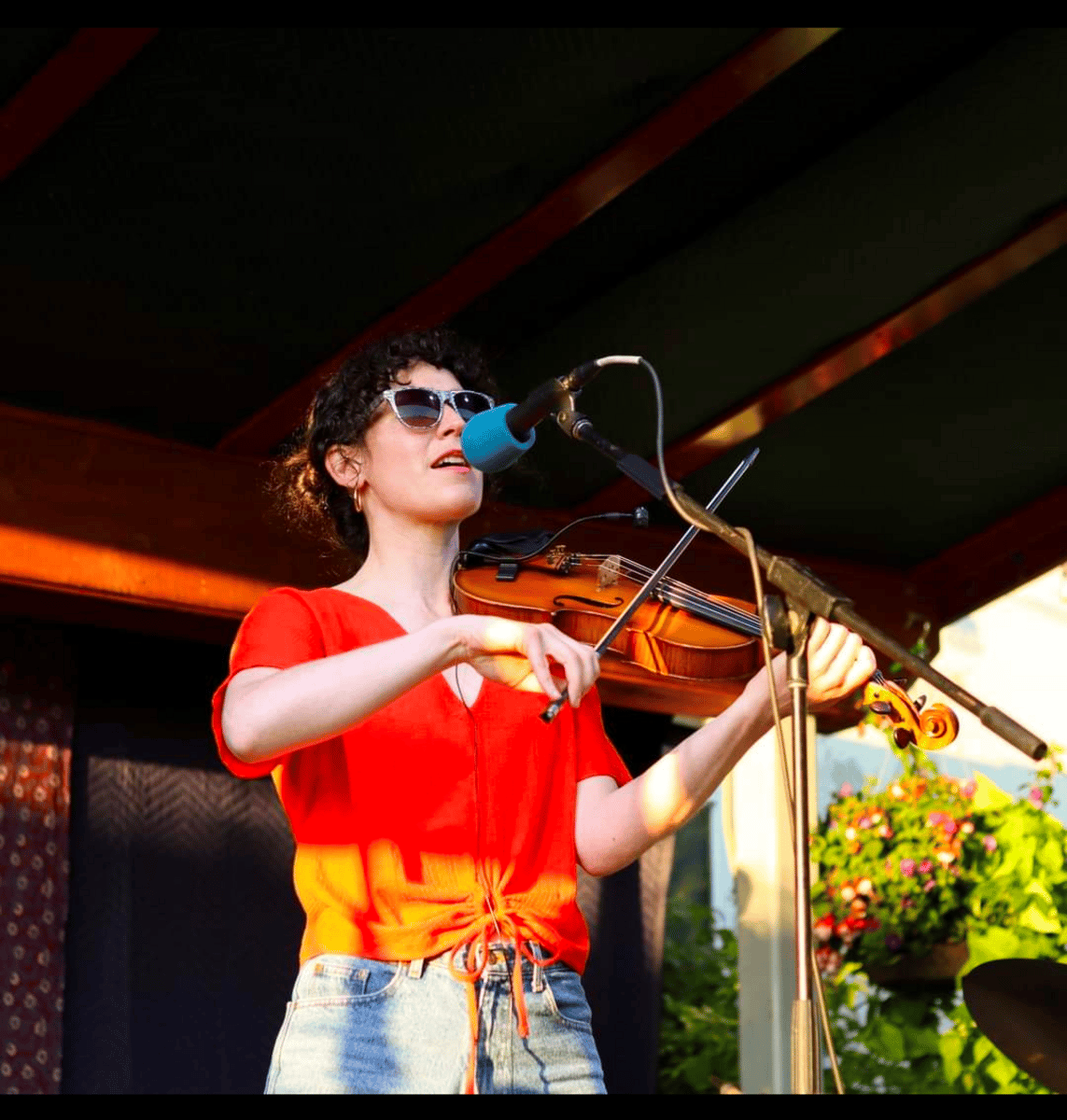
I have a new motto. I forget when I started having a motto but I've had a few since then. I change it whenever it needs updating or I'm ready to shift my focus. For the last year or so it's been "get curious." It works for so many things. Triggered? Get curious. Someone is coming at you? Get curious. Feeling awkward at a social gathering? Get curious! It mostly translates to "ask questions" but that doesn't sound like something you'd put on a bumper sticker. (If you choose to jump on the bandwagon and come up with your own personal temporary motto, that is one of the criteria).
My new motto, for now, is "follow what's interesting." It goes nicely with the idea of "chasing the weirdest and most resourceful version of ourselves" that was brought to my attention recently. I am attempting to do both of these things. It’s hard work. I’ll explain…
“Follow what’s interesting” is something Sam Amidon said at a workshop he gave the evening of the second day of classes. I wrote it down in my notes. Sam is a singer, song-writer, and multi-instrumentalist from Brattleboro, VT. He described how after a successful career as a fiddle player he became frustrated with the gap between what he was listening to and what he was playing. He had my full attention. This is how I feel much of the time! How did he resolve this conundrum? Well, he tried a lot of things but ultimately set the fiddle down for about 10 years. I left the hall in a daze. Set the fiddle down?? There must be another way.

Having a think near Allihies in West Cork
Thursday morning, 9 am, fourth day of classes. I go to a class called Digital Music & Media Composition (I was told we could sit in on any class during the first two weeks of classes so I went to pretty much everything I could). I was captivated. I’m not usually much of a note-taker but I couldn’t stop writing. And the conversations they were having! I felt like I was in the right place in a way that I never quite have in a room full of quote unquote musicians. I talked to the professor about joining the class. I talked to my program director about taking it. I went home and looked and re-looked at the class offerings and tried various combinations of credits and schedules, trying to figure out how to get what I want. And what is it that I want? I wrote pages trying to get to the bottom of it.
Each think session would lead me to a version of the same conclusion: what I want is to be free to explore and experiment while in dialogue with people who are not just comfortable but excited about thinking and existing outside of the box. One of my favorite thinkers of our time, Alok Vaid-Menon, talks about how some people think freedom of choice is being given a menu of options to choose from. They then ask: “Is it really a choice when you don't get to select the options you are given to begin with?” The Irish Traditional Music program is designed to accommodate people like me who are questioning things like how tightly we choose to hold onto the past, and how to create a version of “traditional musician” that doesn’t feel like an itchy sweater or a heavy backpack. Within a week it became increasingly clear that while possible, it would be a struggle.

Andy Irvine at Coughlan’s Bar. He’s the real deal.
The next week was stressful and chaotic as I tried to keep up with both the MA in Irish Traditional Music and the MA in Experimental Sound Practice, while crafting a whole new application package to submit (cue the tiny violins! → click play below). I’d like to drag this out so y’all feel the angst and the drama that was banging out my application in six non-stop hours on Saturday, submitting it that evening before I went to see Andy Irvine at Coughlan’s, and then when I didn’t hear back right away, mentally tearing it apart and wishing I had slept on it and done one last revision. Monday night I was psyching myself up to make the most of the trad program. Tuesday morning there was an email in my inbox approving the transfer. That afternoon, my new cohort and I brought resonant objects to class and played with contact mics, trying to make interesting sounds (“not too musical”). There was laughter and whimsy and wonderful sounds and surprisingly disappointing sounds. Most of the time, in most of the classes, things feel so new that I don’t even know what questions to ask. Which is very exciting.
A piece I made as one of my portfolio submissions: “Énouement is a tune I wrote after John Koenig’s word for the bittersweetness of arriving in the future with answers you can’t share with your past self. The piece begins with street sounds outside my window in Cork, layered with an ambient fiddle improvisation. A written melody begins partway through, merging with the rhythm of a car’s reversing alarm. Later, one of my first intentional field recordings, captured years ago in my hometown of Bellingham, WA, joins the soundscape with gusts of wind and the metallic ping of a flag pole rope. This piece is both a musical reflection and a message to my past self.”
I love trad music. It can be achingly beautiful and raucously joyful and its preservation and existence as a living tradition is important. I am still here to learn more about the music, dance, language, and culture of a place that has shaped me in known and unknown ways. I am also here to be the weirdest and most resourceful version of myself that I can be.
I’m not certain where this new direction will lead me. But I prefer to be a gardener—planting seeds and seeing what grows.
What I’m listening to
Makaya McCraven, In the Moment
“Nearly 48 hours of live improvised performance recorded at 1 venue over 12 months and 28 shows - culled, cut, rendered, and remixed into 19 potent pieces of organic beat music.”
Sawako
Everything of Sawako’s! I can’t even pick a favorite album. I also love this interview with her. I was so saddened to learn that she passed away in March 2024, it feels like such a loss.
Hildegard Westerkamp, Kits Beach Soundwalk
“The original recording on which this piece is based was made on a calm winter morning, when the quiet lapping of the water and the tiny sounds of barnacles feeding were audible before an acoustic backdrop of the throbbing city. In this soundwalk composition we leave the city behind eventually and explore instead the tiny acoustic realm of barnacles, the world of high frequencies, inner space and dreams.”
